test blog


Howzit friends,
There’s one sentence I have heard in almost every first conversation I’ve ever had with a business owner, and it really doesn’t matter whether they’re turning over two hundred grand a year or twenty million. It comes out roughly the same way every single time.
“Kenneth, I just need more customers.”
That seems obvious and totally logical, doesn't it? Business feels a bit slow, the bank account is looking thinner than you’d like, which means you’re probably not sleeping as well as you should (that means more grumpiness for sure) so surely the answer has to be more people coming through the door. More leads, more traffic, a bigger ad budget.
Hustle, hustle, hustle… (btw, the hustle culture is not my vibe to be honest)
Here’s the problem, though…getting a brand new customer is the single most expensive thing you will ever do in your business. Not one of the expensive things, the most expensive thing. And most businesses have built their entire growth plan on top of it, with absolutely nothing behind it to not only bring that customer in once they’ve arrived, but to keep them and move them up your product offerings.
Focusing only on acquisition- that’s the fool’s game. And just so we’re clear, I’m not having a go at advertising here, because I love advertising and I’ve made a very good living from it. What I’m having a go at is advertising into a business that has no back end, i.e., thinking that acquisition is the one and only thing.
I know the acquisition trap very well (in fact, I courted it for too long), because I was trapped in it myself for about fourteen years, and it cost me a lot of money, a lot of worry and copious amounts of stress and sleepless nights.
I want to help you and show you a better and different way to go about your marketing. It’s going to change what you spend your money and your energy in the future.
Revenue is only ever three numbers
Let’s strip business right back to the bone. Whatever you sell, wherever you sell it, your revenue is only ever three numbers multiplied together.
Revenue = Customers × Value per order × Frequency of purchase.
Or, as I scribble it on the whiteboard, R = C × V × F.
C is how many customers you have.
V is how much each one spends when they buy, which is your average order value.
F is how many times a year they come back and buy from you again.
That’s honestly it, and it’s beautifully simple. In fact, you could explain this to a ten-year-old over breakfast (as long as they don't have a screen in front of their face…LOL). How many people buy from you, how much do they spend, and how often do they come back?
Let’s put some real numbers on that example, to make it a little more concrete. Say you’ve got a business turning over $500,000 a year:
Customers - 1,000
Average order value - $250
Purchases per customer per year - 2
Annual revenue - $500,000
1,000 × $250 × 2 = $500,000. Nice and simple.
Now the owner comes along and says, “Right, Kenneth, I want to get to $750,000 this year. Another quarter of a million on the top line, please.”
You’ve got three doors you can walk through to get there.
Door one: more customers
You go from 1,000 customers to 1,500, and this is the door that almost everybody reaches for. It’s the most obvious, right?
But have a proper look at what that actually asks of you. In order to hit that target, you need 50% more traffic and 50% more leads. That means you’ll need a materially bigger ad budget, more sales conversations, more proposals, and enough capacity to deliver all that extra work once it lands. And every single one of those extra customers has to be bought and paid for.
More spend, more risk, and a lot more moving parts.
Door two: a bigger order value
Here, you leave your customer count exactly where it is, and instead you raise the average order value from $250 to $375.
There are many ways you can do that, such as raising prices, providing order bundles, order bumps, upsells, complementary products, etc. With this approach, you don't need new traffic, and you don't risk extra ad spend.
Door three: more frequency
Same 1,000 customers and the same $250 order, but instead of buying from you twice a year, they buy three times. You just get them coming back more often
You do that with reminders, emails, SMS, a phone call, reorder prompts, subscriptions, auto-ship, events and seasonal offers. And again, there’s no new traffic and no extra ad budget needed.
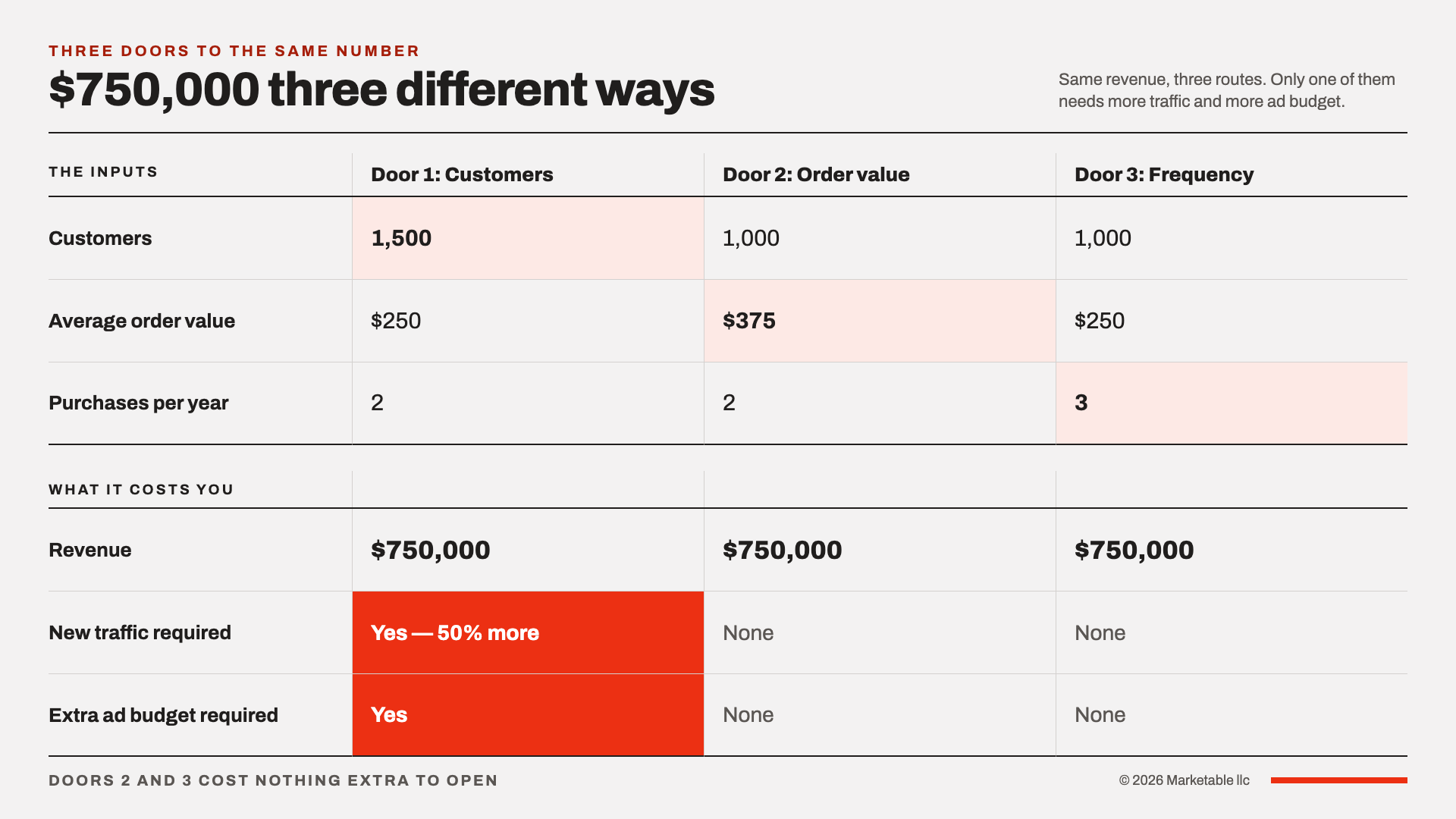
Three doors, exactly the same destination, and two of them cost you nothing at all in ad spend.
Now in the real world you’re probably going to open all three doors a little bit rather than one of them all the way, and the right mix depends entirely on what kind of business you’re in. A supplement company and a custom home builder are never going to have the same answer, so the right door depends on your business, not on habit.
But look at what actually happens out there in the real world. Almost everybody reaches for door one. The most expensive door and the one that appears to be the most obvious. Just go buy more customers.
And I want to be really clear here, because people do sometimes misread me on this one. I am not anti-acquisition, and you always have to be feeding the conveyor belt. A business that stops bringing new people in eventually dies. What I am against, though, is the focus on acquisition being the only thing you do, because that’s exactly where the whole thing gets fragile.
The number nobody wants to talk about: your margin
Before you go judging a single marketing number, you have to know one thing about your business: what do you actually get to keep (which I’m sure you’ll agree is the important part)?
Your profit is your revenue multiplied by your margin.
And if you’re not familiar with gross margin, it’s simply what’s left out of every sale after you’ve paid the direct costs of delivering the thing you sell. For a physical product that’s the product itself, the packaging, the shipping and the payment fees. For a service business it’s mostly the people doing the work. It’s the money that is genuinely yours before the rent, the software, the tax and everything else comes along and takes its slice.
The margin is wildly different depending on what you sell: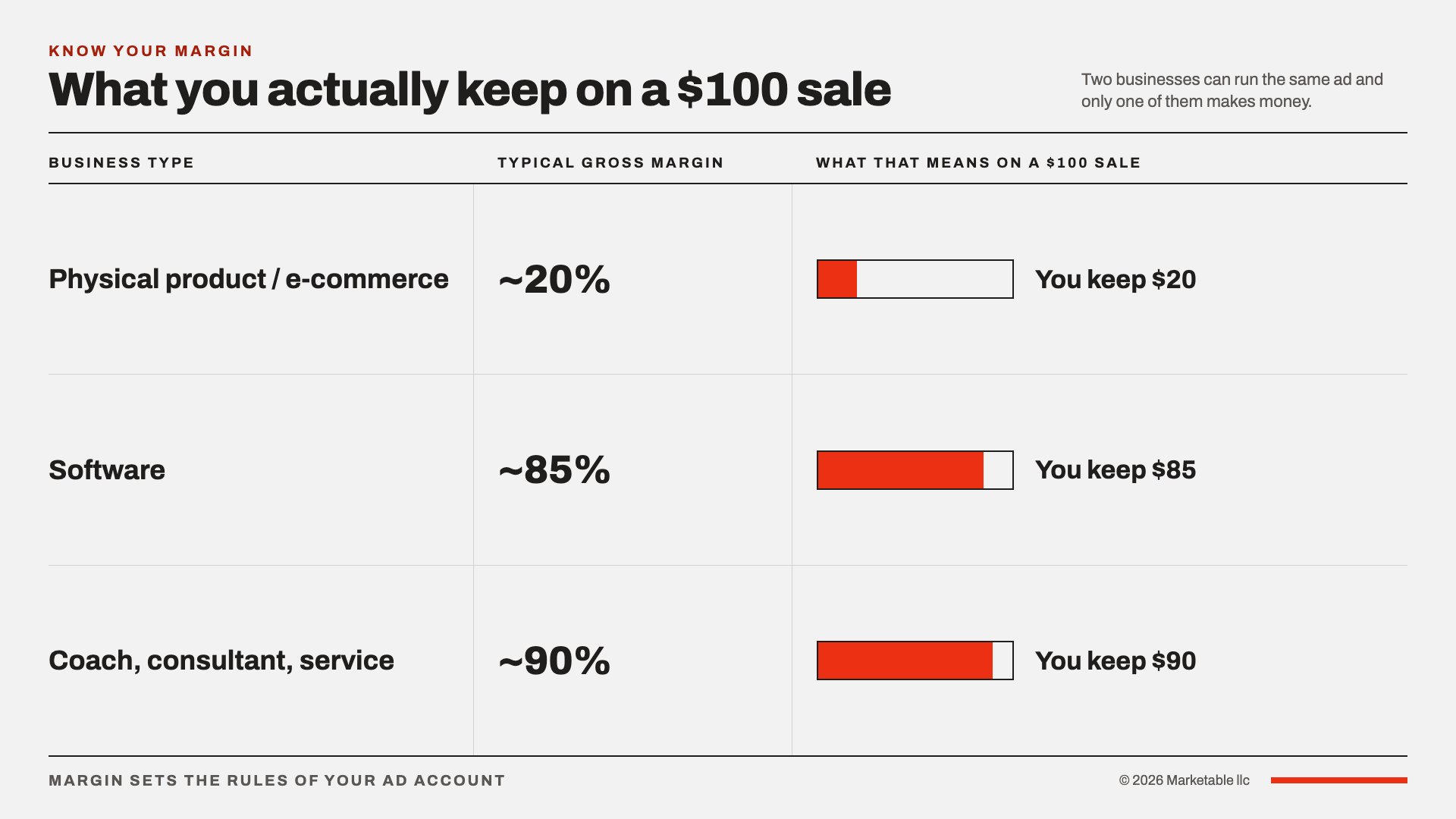
Bear in mind these are just averages or guidelines, so your business may be different. The most important piece, is that you know your number and if you don’t know what it is, that’s the very first thing to go and find out.
Ok, so here’s a nugget for you to consider…
Your margin sets the absolute maximum you can ever pay to acquire a customer.
On a $100 sale at a 20% margin, your gross profit is $20. So the most you can possibly spend to win that sale and still break even is $20. Spend $25, and you start losing money and there is a crazy twist to this too, which we’ll get to in a second. More about this in a second, but even though you are losing money, your ad buyer may be telling you that they are making money. Hmmmm!
This is a common problem and so not to worry; you are not alone. The marketing person is celebrating and saying “what’s the problem, I spent $100 and brought in $300 of sales; that’s a three-times return on ad spend.”
Meanwhile, the finance person is saying, “This is not good, we’re bleeding money, cut it.” And you, the confused owner, are sitting in the middle, wondering who on earth to believe.
Oh, and while we’re here, return on ad spend (or ROAS, as you’ll hear it called) simply means the revenue you got back for every dollar you put in. Spend $100 and get $300 back, that’s 3x ROAS.
They’re both right, by the way, but they’re both looking at half the picture. The marketing number is revenue, and the finance number is what’s left over. Your job, or your CMO’s job, is to get those two numbers talking to each other properly, so you get to see the full picture.
Once you know your margin, you can work out what your ads actually have to return just to stand still:
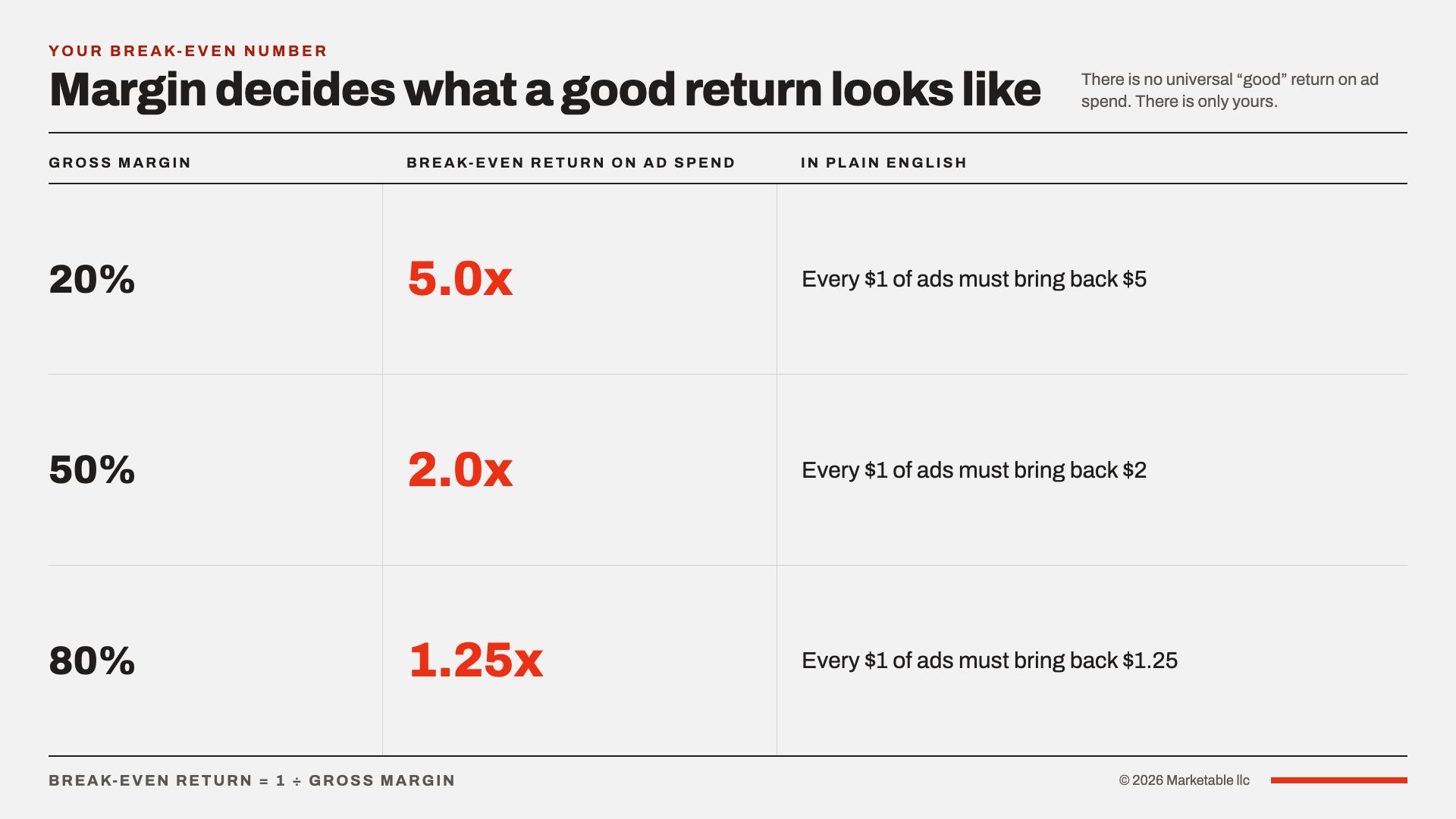
Have another sniff at that top row, because it’s a brutal one. A 20% margin business needs a five-times return on cold traffic just to break even. Five times, to an audience who has never heard of you, on a first purchase. That is pretty darn difficult to do, and most people never get anywhere near it.
So how does anybody make money at all? Well, that’s where the back end comes in, and that’s really what this whole article is about.
The front end and the back end
Every business has two halves, and they do completely different jobs.
The front-end is acquisition. It’s how you get somebody through the door, which is the work of your ads and content, your offer and your first sale to a customer/client. Its only real job is to buy you a customer at a price the market will accept. That’s it, that’s the whole job.
The back-end is everything that happens after that first purchase. The second sale, the upgrade, the renewal, the service plan and the next thing they need from you, i.e., the ascension in the buyer's journey.
So the front end buys you the customer, and the back-end is where all the cream is, i.e., profit. So many businesses are stuck in the acquisition cycle as they have no back end, and so every single month they start from zero. It’s relentless and exhausting.
So let’s take a look at some well known businesses that really highlight the power of a strong front-end and back-end model to their business.
Have a look at a car dealership
We all drive past a dealership lot and think those people must be absolutely printing money. Cars are $60,000, $70,000, and a hundred grand for a truck now. When on earth did trucks become $100,000?
But here’s the thing, the car itself is the thinnest part of the whole deal. The dealer might make one to two and a half grand on a new car. Where the money actually comes from is everything they stack around it: the finance and insurance spread, the extended warranty, the paint protection coating, the trade-in they buy off you for $10,000 and quietly turn around at $15,000, and then five to ten years of servicing.
Here’s what that looks like in the published financials of AutoNation, one of the biggest dealer groups in the US:
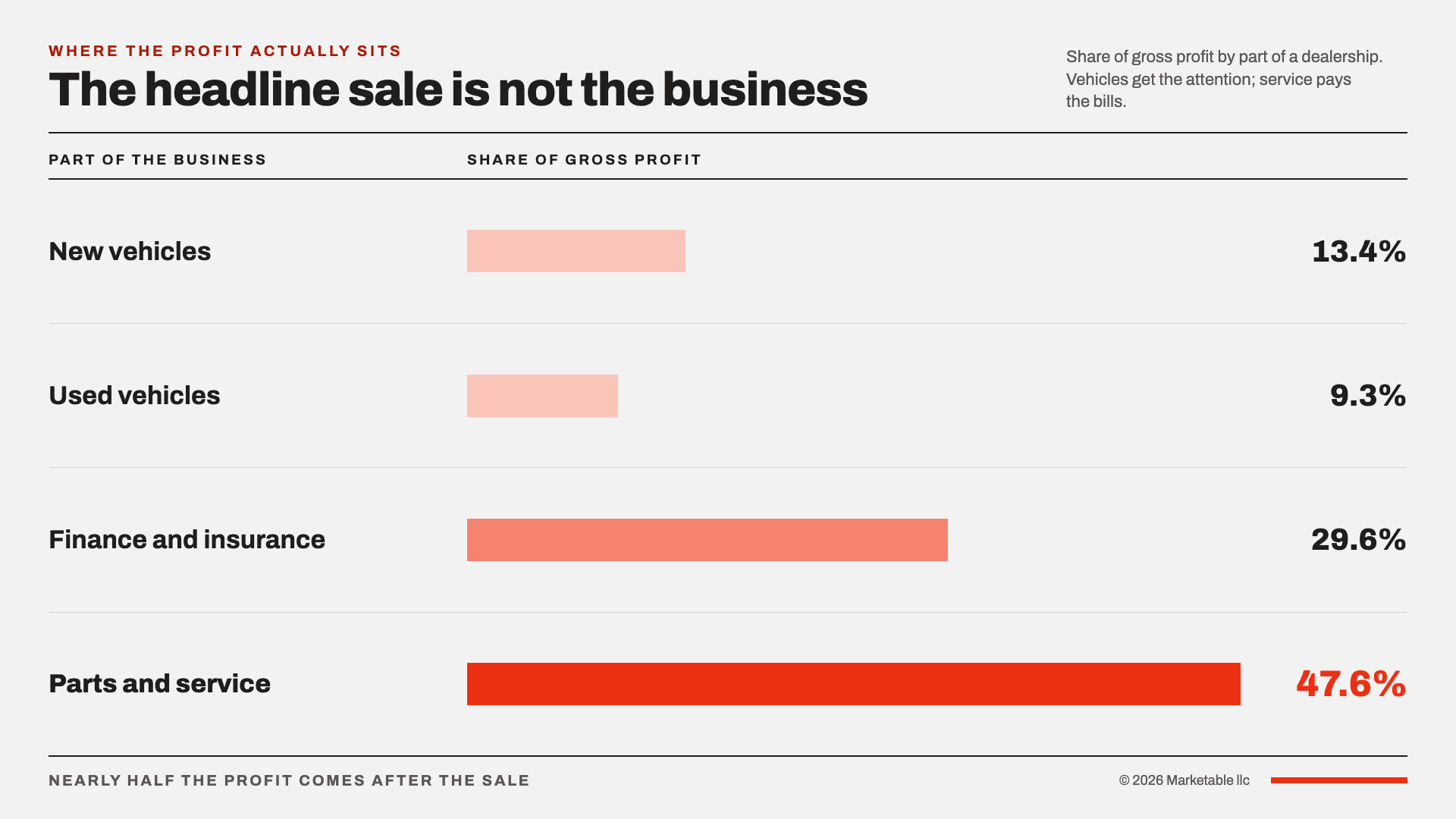
Selling cars, which is the entire thing you and I think their business actually is, produces under a quarter of their gross profit. More than 77% of it comes from finance, insurance, parts and service, and every bit of that is back-end.
That’s also why the salesperson isn’t nearly as excited as you’d expect when you tell them you’re paying cash. Years ago, that got you a lovely discount when you offered them cash. Try it today and watch their face. They’re not interested in your briefcase full of cash, because cash cuts them right out of the financing spread, and the financing spread is where they were planning to make their money.
Have a look at Chewy
Chewy sells pet food, cat litter and squeaky toys (and a number of other items). Their entire business model is to win the pet owner on the first order, make replenishment ridiculously convenient, and then gradually capture more and more of whatever that new customer spends on their beloved pet.